The Living Manuscript
Major Arcana · XI
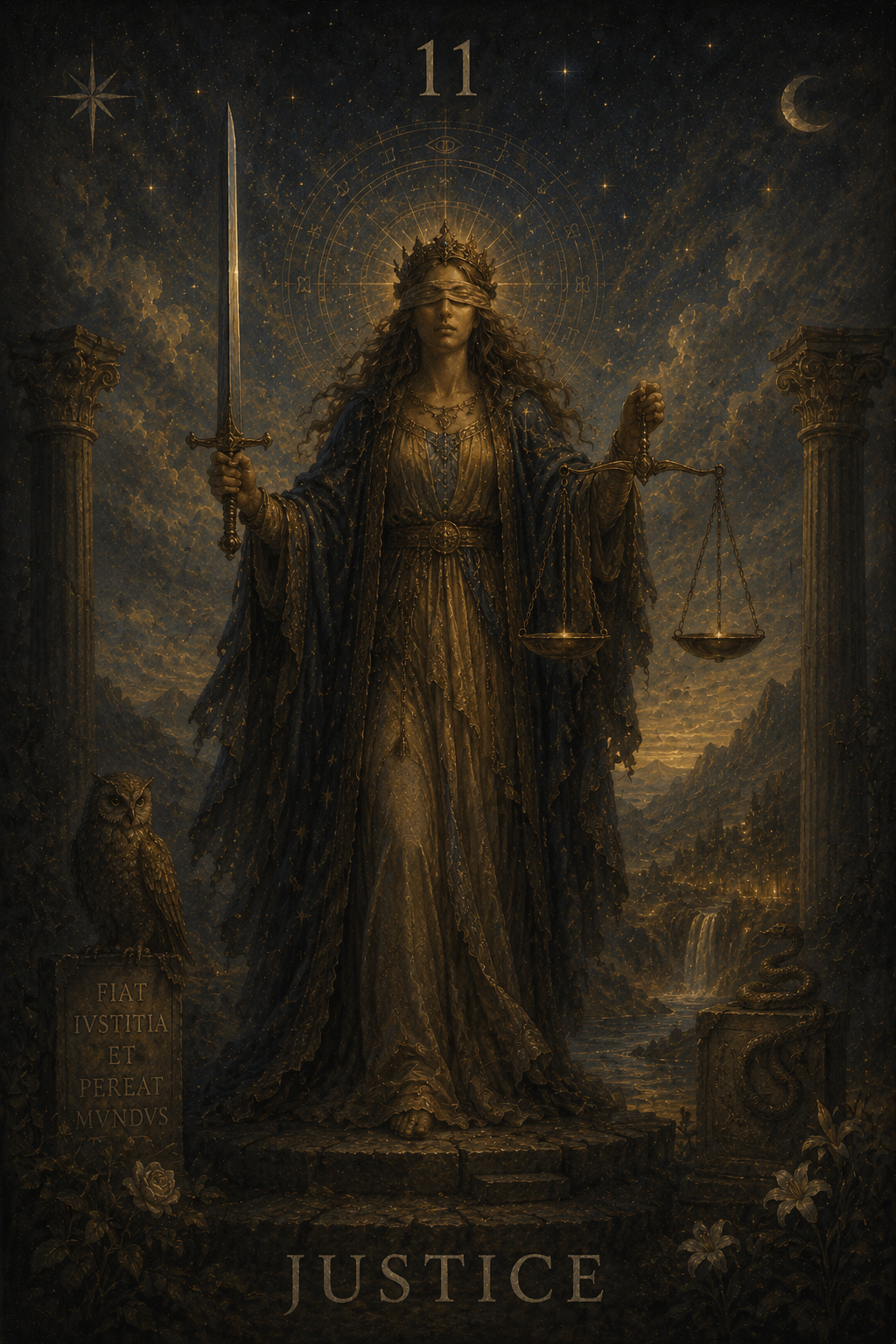
Justice Tarot Card Meaning
Truth restores balance when responsibility is allowed to enter.
Truth · Accountability · Fairness · Integrity · Consequence · Ethics · Discernment · Responsibility
Archetypal Message
The Card Speaks
Justice represents the relationship between truth, choice, and consequence. It asks for clear perception, ethical responsibility, and the willingness to accept that actions continue shaping reality after intention has passed.
Upright Meaning
Truth, fairness, accountability, ethics, balance, responsibility, legal matters, clear decisions, integrity, and consequences aligned with previous choices.
Reversed Meaning
Dishonesty, unfairness, avoidance of accountability, biased judgment, unresolved consequences, denial, legal complications, or difficulty making an ethically clear decision.
Truth · Accountability · Fairness · Integrity · Consequence · Ethics · Discernment · Responsibility
Shadow
Fairness becomes punishment. Justice may hide bias behind objectivity, use truth without compassion, or demand accountability from others while remaining unwilling to examine personal responsibility.
Reflection
What truth requires my accountability, even if my intentions were different from the impact?
Keywords, correspondences, and card identity
Anatomy of Justice
Perspective
Two Ways Through the Threshold
In traditional tarot, Justice concerns fairness, truth, ethics, legal matters, accountability, consequences, integrity, and clear judgment. It asks for an honest assessment of what has been done, including both intention and impact.
Justice reveals that every action leaves a shape behind it. Intention matters, but it does not erase consequence. Clarity emerges when the desire to appear innocent gives way to the willingness to understand what has actually been created.
Card Interpretations
How Justice May Appear in Your Life
1 of 5
Major Arcana
Journey Through the Arcana
XI · Justice
- Stage
- Accountability
- Gift
- Discernment
- Lesson
- Accept cause and consequence
- Risk
- Punitive certainty
XII · The Hanged Man
Judgment pauses so perspective can change.
The Wheel of Fortune reveals movement beyond personal control. Justice identifies the responsibility that remains within that movement, while The Hanged Man suspends judgment and action long enough for an entirely different perspective to emerge.
Learning the Card
Questions from the Seeker
Justice is rarely a guarantee, but it can lean yes when the outcome is supported by truth, fairness, and accountable decision-making. Its guidance is strongest when you meet the situation consciously instead of expecting timing, effort, or emotion to arrange everything on your behalf.
Justice can be constructive because it develops truth, fairness, and accountable decision-making. Its difficult expression is also valuable information: it shows where bias, denial, punitive certainty, or avoidance of consequence needs attention before a healthier direction can become available.
Justice may describe someone principled, discerning, direct, ethically minded, or concerned with fairness and responsibility. In a difficult expression, the same qualities may become colored by bias, denial, punitive certainty, or avoidance of consequence, especially if self-awareness or accountability has been lost.
Look at the facts, include context, and accept responsibility for the impact of your choices before deciding what repair or boundary is needed. The card does not require a dramatic answer; it favors a deliberate response that makes room for reality, consequence, and the insight gained by staying present.
Reversed, Justice may warn of bias, denial, punitive certainty, or avoidance of consequence. The warning is not a fixed prediction. It invites you to identify the pattern, take responsibility for what is within reach, and choose a more sustainable response.
A repeating Justice may highlight an ongoing lesson around integrity, accountability, and the consequences that continue after a choice has been made. Repetition often points to an unfinished lesson rather than a predetermined outcome, giving you another opportunity to notice how your choices, habits, and attention are participating in it.
Reflection Questions
What responsibility becomes visible when I stop defending my intentions?
Where would greater honesty restore balance?