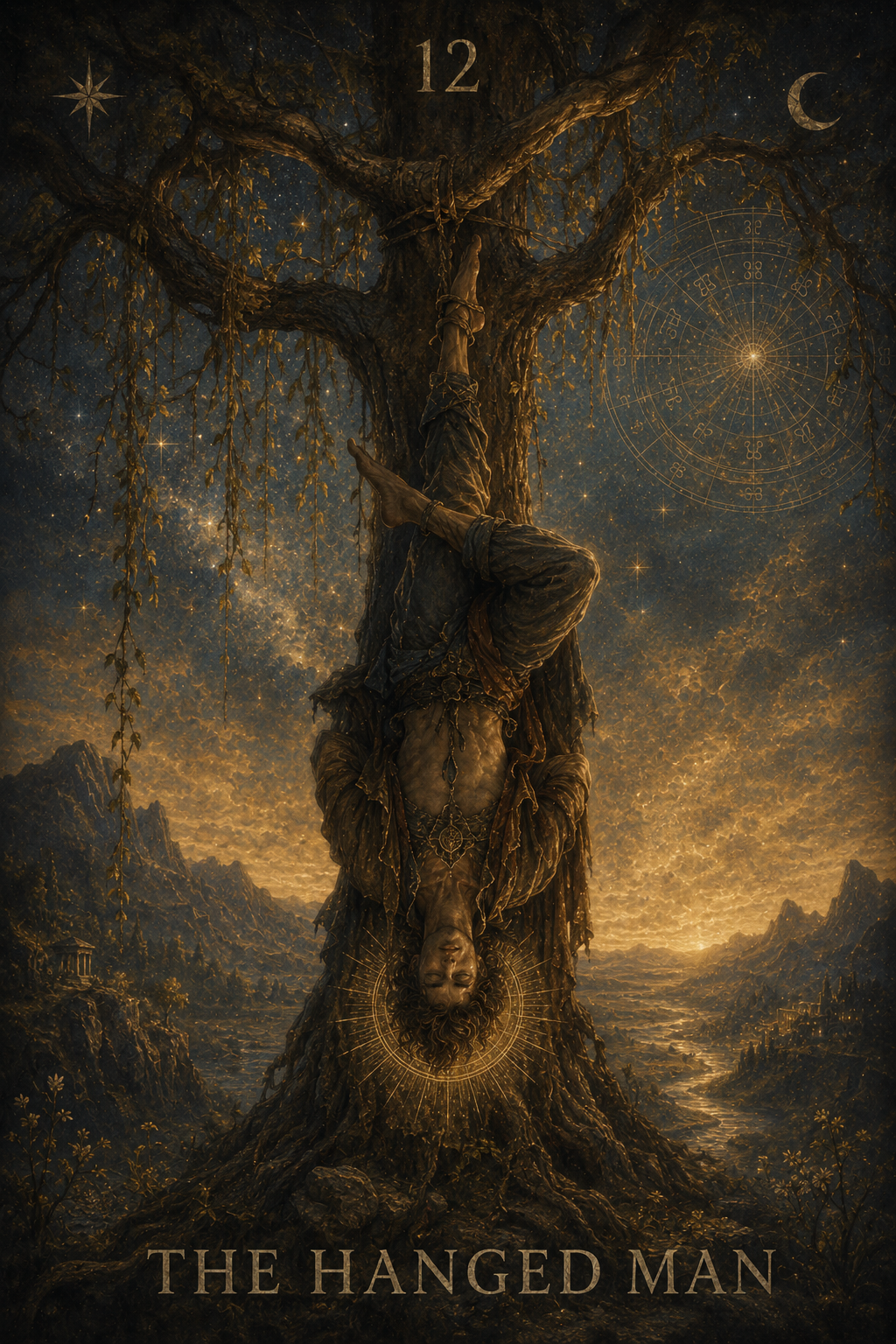
The Living Manuscript
Major Arcana · XII
The Hanged Man Tarot Card Meaning
A different truth appears when the familiar view is released.
Surrender · Perspective · Suspension · Patience · Release · Acceptance · Sacrifice · Insight
Archetypal Message
The Card Speaks
The Hanged Man represents the pause in which familiar understanding is suspended. By releasing immediate control, a different perspective becomes possible and hidden assumptions can finally be seen.
Upright Meaning
Surrender, pause, perspective, release, patience, suspension, meaningful sacrifice, acceptance, and allowing insight to emerge before acting.
Reversed Meaning
Stagnation, resistance, pointless delay, indecision, avoidance, martyrdom, unwilling sacrifice, or remaining suspended after the necessary insight has already arrived.
Surrender · Perspective · Suspension · Patience · Release · Acceptance · Sacrifice · Insight
Shadow
Surrender becomes self-abandonment. The Hanged Man may glorify suffering, wait indefinitely to avoid responsibility, or use sacrifice as a way to create guilt and moral superiority.
Reflection
What becomes visible when I stop forcing movement, and what am I postponing without purpose?
Keywords, correspondences, and card identity
Anatomy of The Hanged Man
Perspective
Two Ways Through the Threshold
In traditional tarot, The Hanged Man represents surrender, pause, new perspective, suspension, patience, release, and meaningful sacrifice. He shows how a temporary interruption can reveal assumptions that more effort would have kept hidden.
The Hanged Man enters the interval between movement and understanding. Nothing has disappeared, yet every relationship changes when viewed from another position. Surrender does not erase agency. It creates enough space for a wiser action to become imaginable.
Card Interpretations
How The Hanged Man May Appear in Your Life
1 of 5
Major Arcana
Journey Through the Arcana
XII · The Hanged Man
- Stage
- Suspended Perspective
- Gift
- Insight
- Lesson
- Release the familiar view
- Risk
- Martyrdom
XIII · Death
Perspective prepares the self to release what has ended.
Justice clarifies the relationship between choice and consequence. The Hanged Man suspends familiar judgment so another perspective can emerge, while Death completes the release of what can no longer continue.
Learning the Card
Questions from the Seeker
The Hanged Man is rarely a guarantee, but it can lean yes when the outcome is supported by patience, release, and a changed perspective. Its guidance is strongest when you meet the situation consciously instead of expecting timing, effort, or emotion to arrange everything on your behalf.
The Hanged Man can be constructive because it develops patience, release, and a changed perspective. Its difficult expression is also valuable information: it shows where stagnation, martyrdom, avoidance, or delay without purpose needs attention before a healthier direction can become available.
The Hanged Man may describe someone reflective, patient, willing to pause, or temporarily seeing life from an unfamiliar angle. In a difficult expression, the same qualities may become colored by stagnation, martyrdom, avoidance, or delay without purpose, especially if self-awareness or accountability has been lost.
Stop forcing the familiar solution long enough to ask what the pause is making visible, then decide when insight needs to become action. The card does not require a dramatic answer; it favors a deliberate response that makes room for reality, consequence, and the insight gained by staying present.
Reversed, The Hanged Man may warn of stagnation, martyrdom, avoidance, or delay without purpose. The warning is not a fixed prediction. It invites you to identify the pattern, take responsibility for what is within reach, and choose a more sustainable response.
A repeating Hanged Man may point to a necessary change in perspective or to a delay that has lasted beyond the insight it was meant to offer. Repetition often points to an unfinished lesson rather than a predetermined outcome, giving you another opportunity to notice how your choices, habits, and attention are participating in it.
Reflection Questions
Which situation needs a new perspective rather than more force?
What could I understand if I released the need for immediate resolution?