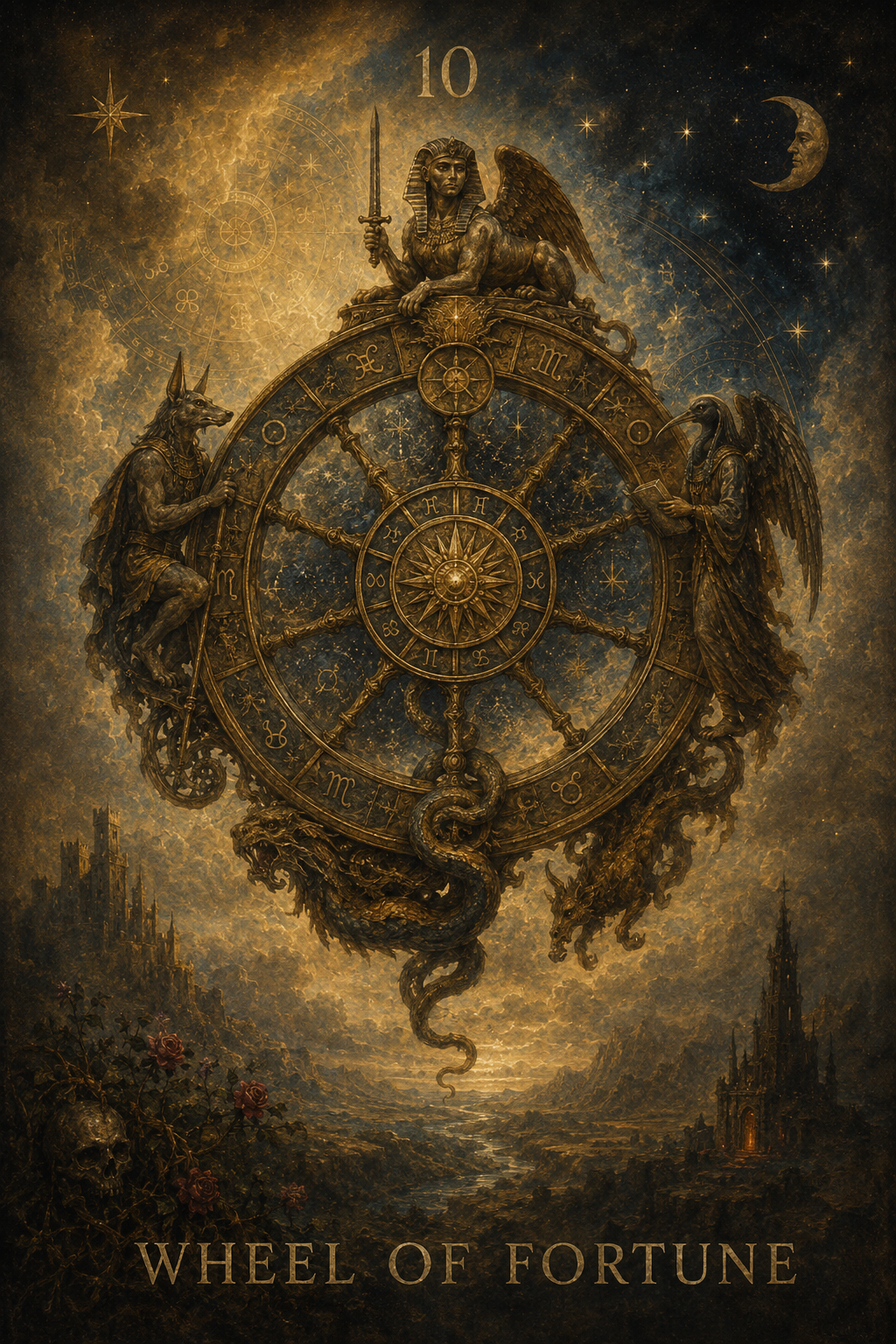
The Living Manuscript
Major Arcana · X
Wheel of Fortune Tarot Card Meaning
The turning world creates openings no stillness could reveal.
Cycles · Change · Turning Point · Timing · Fortune · Movement · Adaptation · Opportunity
Archetypal Message
The Card Speaks
Wheel of Fortune represents the movement of cycles that continually reshape circumstance. It teaches that control is limited, but awareness, preparation, and response still influence what becomes possible when conditions change.
Upright Meaning
Change, cycles, turning points, opportunity, timing, movement, good fortune, adaptation, cause and effect, and entering a new phase.
Reversed Meaning
Resistance to change, delays, repeated patterns, poor timing, instability, unexpected setbacks, feeling powerless, or failing to recognize one’s role within a recurring cycle.
Cycles · Change · Turning Point · Timing · Fortune · Movement · Adaptation · Opportunity
Shadow
Change becomes an excuse for passivity. The Wheel may encourage someone to call repetition fate, wait for luck to repair avoidable problems, or surrender responsibility to forces they refuse to examine.
Reflection
What cycle is turning in my life, and how am I participating in its repetition or transformation?
Keywords, correspondences, and card identity
Anatomy of Wheel of Fortune
Perspective
Two Ways Through the Threshold
In traditional tarot, Wheel of Fortune represents cycles, fate, fortune, timing, change, turning points, opportunity, and forces beyond immediate control. It emphasizes adaptability and awareness of the choices that still matter within changing circumstances.
The Wheel reveals existence as movement rather than permanence. Circumstances turn, identities change, and endings quietly prepare conditions for beginnings. You cannot command the entire cycle, but you can become more conscious of how you meet its arrival.
Card Interpretations
How Wheel of Fortune May Appear in Your Life
1 of 5
Major Arcana
Journey Through the Arcana
X · Wheel of Fortune
- Stage
- The Turning Cycle
- Gift
- Adaptability
- Lesson
- Meet change consciously
- Risk
- Fatalism
XI · Justice
Changing conditions reveal consequence and accountability.
The Hermit discovers wisdom through reflection. The Wheel of Fortune returns that wisdom to a changing world, where timing and circumstance cannot be controlled, while Justice reveals how choices and consequences continue shaping the turning cycle.
Learning the Card
Questions from the Seeker
Wheel of Fortune is rarely a guarantee, but it can lean yes when the outcome is supported by adaptation, timing, and conscious participation in change. Its guidance is strongest when you meet the situation consciously instead of expecting timing, effort, or emotion to arrange everything on your behalf.
Wheel of Fortune can be constructive because it develops adaptation, timing, and conscious participation in change. Its difficult expression is also valuable information: it shows where fatalism, repeated patterns, or waiting for luck to replace responsibility needs attention before a healthier direction can become available.
Wheel of Fortune may describe someone adaptable, responsive to timing, comfortable with change, or learning to recognize a recurring pattern. In a difficult expression, the same qualities may become colored by fatalism, repeated patterns, or waiting for luck to replace responsibility, especially if self-awareness or accountability has been lost.
Notice the cycle that is moving and choose a response that prepares you for change rather than clinging to what is already shifting. The card does not require a dramatic answer; it favors a deliberate response that makes room for reality, consequence, and the insight gained by staying present.
Reversed, Wheel of Fortune may warn of fatalism, repeated patterns, or waiting for luck to replace responsibility. The warning is not a fixed prediction. It invites you to identify the pattern, take responsibility for what is within reach, and choose a more sustainable response.
A repeating Wheel may reveal a recurring cycle and invite you to distinguish what is outside your control from the choices that keep feeding the pattern. Repetition often points to an unfinished lesson rather than a predetermined outcome, giving you another opportunity to notice how your choices, habits, and attention are participating in it.
Reflection Questions
What change is asking me to adapt rather than cling?
Which repeated pattern am I now able to recognize?