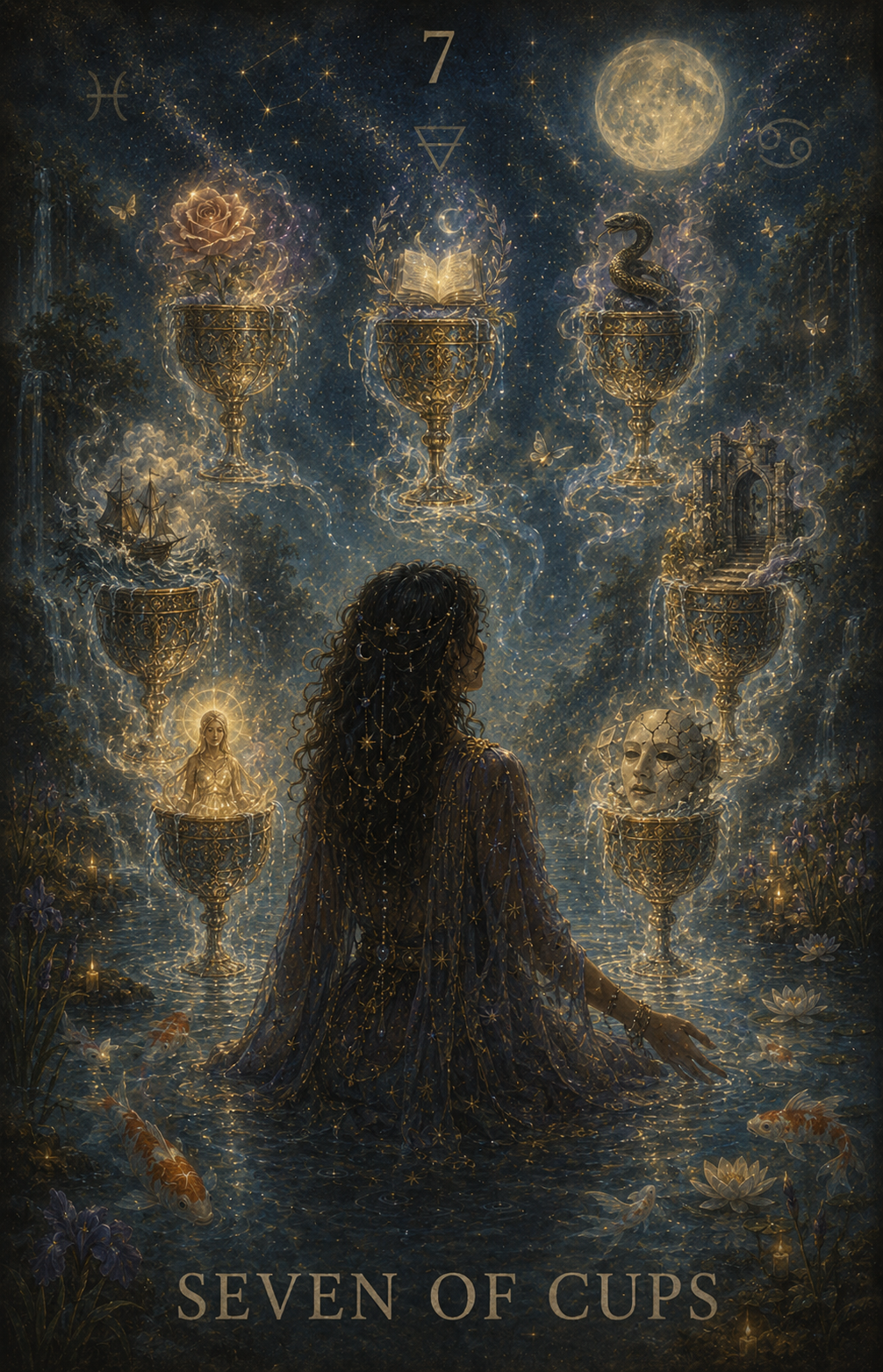
The Living Manuscript
Cups · Seven
Seven of Cups Tarot Card Meaning
Possibility becomes meaningful when imagination agrees to meet reality.
Possibility · Fantasy · Choice · Imagination · Desire · Illusion · Projection · Temptation
Archetypal Message
The Card Speaks
The Seven of Cups represents possibility multiplied through imagination and desire. Many paths appear emotionally compelling, but discernment is required to distinguish genuine opportunity from projection, fantasy, and avoidance.
Upright Meaning
Choices, possibilities, imagination, fantasy, illusion, desire, temptation, projection, emotional complexity, and the need to clarify what is truly meaningful.
Reversed Meaning
Clarity, narrowing choices, making a decision, recognizing illusion, releasing fantasy, emotional focus, avoiding temptation, or becoming overwhelmed by too many possibilities.
Possibility · Fantasy · Choice · Imagination · Desire · Illusion · Projection · Temptation
Shadow
Imagination becomes escape. The Seven of Cups may fall in love with potential rather than reality, preserve every option to avoid commitment, or project desire onto people and paths that cannot carry it.
Reflection
Which possibility is supported by reality, and which one survives mainly because I want to believe in it?
Keywords, correspondences, and card identity
Anatomy of Seven of Cups
Perspective
Two Ways Through the Threshold
In traditional tarot, the Seven of Cups concerns choices, fantasy, illusion, desire, temptation, imagination, projection, emotional possibility, and discernment. It asks that a compelling vision be tested against evidence, limitation, and the commitments required to make it real.
The Seven of Cups reveals how desire creates worlds before experience confirms them. Imagination can widen the future, but every vision must eventually encounter evidence, limitation, and choice.
Card Interpretations
How Seven of Cups May Appear in Your Life
1 of 5
Minor Arcana
Journey Through the Suit
Seven of Cups
- Stage
- The Dreaming Crossroads
- Gift
- Imagination
- Lesson
- Choose with emotional discernment
- Risk
- Escapism
Eight of Cups
Fantasy gives way to the difficult recognition that something must be left behind.
The Six of Cups returns to memory and emotional familiarity. The Seven of Cups expands that inner world into fantasy, choice, and possibility, while the Eight of Cups asks which emotional investment must be released when possibility can no longer conceal dissatisfaction.
Learning the Card
Questions from the Seeker
Seven of Cups is not a guarantee, but it can lean yes when the outcome is supported by imagination, possibility, and grounded discernment. Its guidance is strongest when you stay responsive to reality rather than expecting emotion or possibility to settle every practical question on its own.
Seven of Cups can be constructive because it brings imagination, possibility, and grounded discernment into clearer awareness. Its difficult expression is also useful information: it shows where fantasy, projection, or avoiding a necessary choice needs attention before a healthier emotional direction can become available.
Seven of Cups may describe a person or emotional approach shaped by imagination, possibility, and grounded discernment. In a difficult expression, the same qualities can become colored by fantasy, projection, or avoiding a necessary choice, especially when self-awareness, boundaries, or honest communication are missing.
Let imagination, possibility, and grounded discernment inform one grounded choice. The card favors a deliberate response that makes room for feeling, consequence, and what the present situation can actually sustain rather than a dramatic gesture meant to resolve everything at once.
Reversed, Seven of Cups may warn of fantasy, projection, or avoiding a necessary choice. This is not a fixed prediction. It invites you to name the pattern, care for what is within reach, and choose a response that restores emotional honesty and agency.
A repeating Seven of Cups may highlight an unfinished lesson around imagination, possibility, and grounded discernment. Repetition does not determine an outcome; it gives you another opportunity to notice how memory, desire, boundaries, and attention are participating in the pattern.
Reflection Questions
Which option remains meaningful after I examine the evidence?
What desire may be shaping how I perceive this situation?