The Living Manuscript
Swords · Five
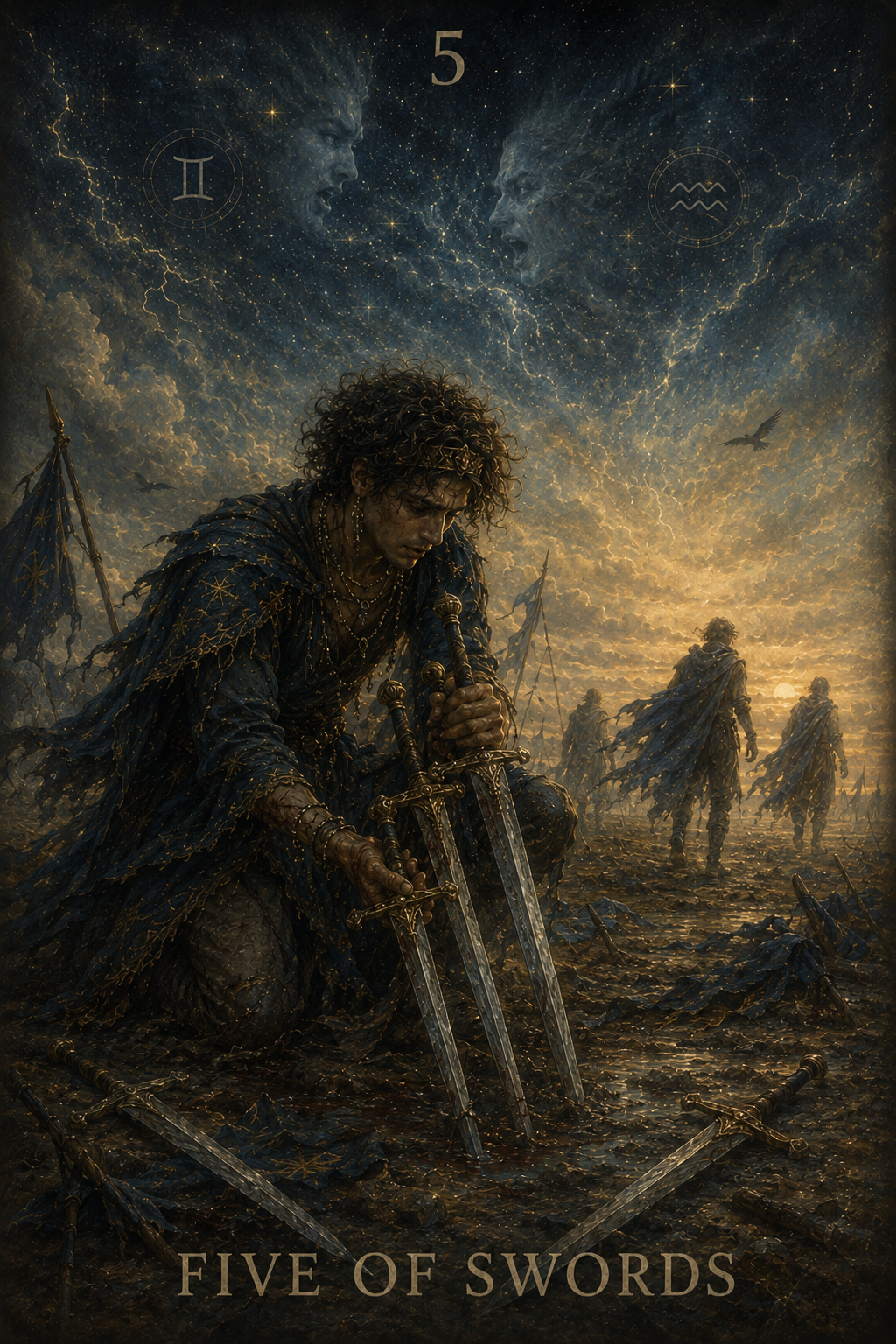
Five of Swords Tarot Card Meaning
Clarity begins when truth is allowed to be seen.
Conflict · Consequence · Victory · Ethics · Tension · Pride · Repair · Choice
Archetypal Message
The Card Speaks
The Five of Swords represents conflict shaped by pride, power, and consequence. A result can be technically victorious while leaving trust, dignity, or relationship damaged.
Upright Meaning
Conflict, tension, defeat, hollow victory, competition, consequences, disagreement, and ethical choice.
Reversed Meaning
Reconciliation, resentment, unresolved conflict, accountability, making amends, or refusing a destructive battle.
Conflict · Consequence · Victory · Ethics · Tension · Pride · Repair · Choice
Shadow
cruelty, humiliation, or victory that destroys trust
Reflection
What is the real cost of needing to win this conflict?
Keywords, correspondences, and card identity
Anatomy of Five of Swords
Perspective
Two Ways Through the Threshold
In traditional tarot, Five of Swords concerns conflict, consequence, and the cost of winning. It asks for discernment and a response rooted in honest communication rather than cruelty, humiliation, or victory that destroys trust.
Five of Swords brings its lesson into clearer awareness. Honest attention makes room for perspective, discernment, and a conscious next response.
Card Interpretations
How Five of Swords May Appear in Your Life
1 of 5
Minor Arcana
Journey Through the Suit
Five of Swords
- Stage
- conflict, consequence, and the cost of winning
- Gift
- Discernment
- Lesson
- Meet conflict, consequence, and the cost of winning consciously
- Risk
- cruelty, humiliation, or victory that destroys trust
Six of Swords
Six of Swords continues the Swords journey.
Five of Swords develops the Swords journey through conflict, consequence, and the cost of winning, while Six of Swords asks what follows when that insight becomes lived experience.
Learning the Card
Questions from the Seeker
Five of Swords offers guidance around conflict, consequence, and the cost of winning. It is not a fixed prediction: notice where cruelty, humiliation, or victory that destroys trust may be narrowing choice, then respond with clarity, proportion, and a practical action that the situation can sustain.
Five of Swords offers guidance around conflict, consequence, and the cost of winning. It is not a fixed prediction: notice where cruelty, humiliation, or victory that destroys trust may be narrowing choice, then respond with clarity, proportion, and a practical action that the situation can sustain.
Five of Swords offers guidance around conflict, consequence, and the cost of winning. It is not a fixed prediction: notice where cruelty, humiliation, or victory that destroys trust may be narrowing choice, then respond with clarity, proportion, and a practical action that the situation can sustain.
Five of Swords offers guidance around conflict, consequence, and the cost of winning. It is not a fixed prediction: notice where cruelty, humiliation, or victory that destroys trust may be narrowing choice, then respond with clarity, proportion, and a practical action that the situation can sustain.
Five of Swords offers guidance around conflict, consequence, and the cost of winning. It is not a fixed prediction: notice where cruelty, humiliation, or victory that destroys trust may be narrowing choice, then respond with clarity, proportion, and a practical action that the situation can sustain.
Five of Swords offers guidance around conflict, consequence, and the cost of winning. It is not a fixed prediction: notice where cruelty, humiliation, or victory that destroys trust may be narrowing choice, then respond with clarity, proportion, and a practical action that the situation can sustain.
Reflection Questions
What truth about Five of Swords am I ready to meet more clearly?
What practical action would honor this insight?